For the first time in Israel, an art museum is devoting the entire venue to the world of illustration. The Herzliya Museum opens the summer with eight new exhibitions and projects featuring the best Israeli illustrators.
More than thirty illustrators of different generations present new, surprising illustration works that leave the confines of the page and assume a variety of material and media expressions in sculpture, textile, photography, animation and more. The series of exhibitions Tell Me More: Moves in Contemporary Illustration comprises solo and group exhibitions, as well as special projects in collaboration with the Edmond de Rothschild Center and monday.com.

Tell Me More:
Moves in Contemporary Illustration
July 24 – November 30, 2023
Opening: Saturday, July 22, 2023, from 10 am to 2 pm
Participants: Ofra Amit, Nino Biniashvili, Alon Braier, Gal Bulka, Maayan Cohen, Ran Daskal, Zeev Engelmayer, Erela, Roni Fahima, Eden Foxiniano, Inbal Gery, Shira Giladi, Ori Greenberg, Sergey Isakov, Noa Kahana, Aviv Katz, Keren Katz, Noa Katz, Shemuel Katz, Michel Kichka, Batia Kolton, Miri Kuntsman, Shelly Levavi, Ben Molina, Lilach Raz, Yael Rosen-Keren, Gai Safran Lulai, Merav Salomon, Gilad Seliktar, Niv Tishbi, Shany Yasmin, Ruth Zarfati
Curator: Yuval Saar
Co-curators: Shua Ben Ari, Inbal Reuven
Chief Curator: Dr. Aya Lurie
Herzliya Museum of Contemporary Art is pleased to present a unique initiative: devoting the entire venue to the world of Israeli illustration and its creators. The Tell Me More series of exhibitions, curated by Yuval Saar, encompasses more than thirty illustrators of different generations featured in eight exhibitions and projects.
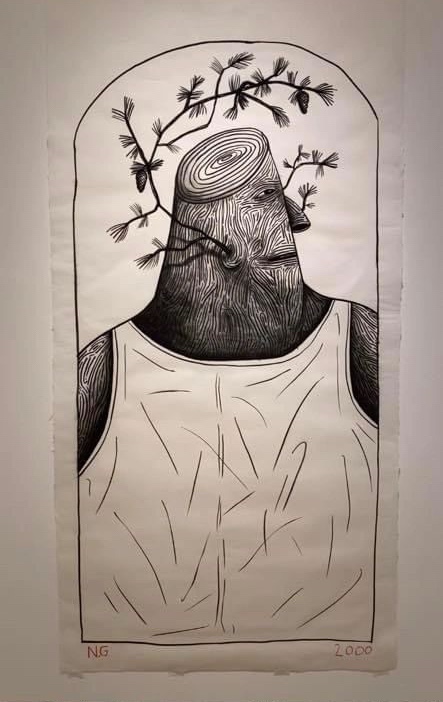
Illustration is one of the most popular fields in visual culture. Ranging from design to art, it is accessible and loved by the general public; it has a story, and is easy to relate to. Tell Me More presents unexpected illustration works that leave the confines of the page and assume a variety of material and media expressions in sculpture, textile, photography, animation and more.
The group of exhibitions Tell Me More seeks to reflect the wide range informing the world of illustration and illustrators – between illustration’s traditional role, of interpreting a text, and illustrations whose raison d’être lies in the artistic intent of their creators. The exhibitions stress the telling of the “story” (in terms of who is doing the storytelling, who is the prospective audience, and the role the artist plays in the story) and – no less importantly – the “more” (that is, why and when we are not satisfied with a given image, and require more, and more).

Roni Fahima & Batia Kolton
Monkey at the Loom
Curator: Yuval Saar | Artistic Consultant: Lior Shvil
The Syrian legend Monkey at the Loom tells of a monkey that is persuaded to learn to weave after its owner makes clear what would happen to it if it does not. It is one of seven tales, folk legends, and myths related to textile crafts on which the works on view by Batia Kolton (b. 1967, Israel) and Roni Fahima (b. 1978, Israel) are based – including texts by the Brothers Grimm, S.Y. Agnon, Norse mythology and others. These allow them to broaden their perspective both on textiles and on theories of storytelling.
Kolton and Fahima refer to themselves as “manual workers” and describe the work on the exhibition as a factory, with a rigid routine and many hours of hard physical labor. The products are love stories that emerge from the textiles and texts. They examine the threads that extend between machine, craft, and textiles – the link between thread and story, fabric and fabrication, text and textiles, the craft of storytelling and that of weaving.
Niv Tishbi: The Carnival
Curator: Yuval Saar
Carnival is a folk ritual that highlights elements of freedom, fantasy, and imagination. It defies the social order by celebrating forbidden desires, breaking boundaries and taboos, and unleashing of passions. The carnival created by Niv Tishbi (b. 1986, Israel) is a large site-specific installation that presents a frozen moment in time – in what may be a celebration, a demonstration, or a military parade; an orderly procession of figures being led or leading, walking in silence or shouting. Tishbi gives free rein to hidden desires; to the appeal of the aesthetics of violence, terrorism, and disasters; to the addiction to anxiety, panic, and the consumption of mass media, which inflames passions and turns horror into entertainment.

Tishbi’s illustration comes off the page – a distinctive characteristic of his work since the start of his career. His sculptural installation allows us to see our lives as an unbridled carnival. It holds up a mirror to the repressed, ugly, sad, and ridiculous impulses and aspects of our daily lives, as well as the amusing ones.
Merav Salomon The Unforgettables
Curator: Yuval Saar
Merav Salomon (b. 1967, USA) tells stories through visual images, almost wordlessly. The exhibition features new works that address the tension between the two forces that have shaped her life: the need to remember and the longing to forget.
At the heart of the exhibition is a series titled The Unforgettables: large-scale charcoal drawings, each devoted to a personal memory of one of Salomon’s loved ones who died before or during her lifetime. The bottom of each drawing is inscribed with the deceased’s initials and the date of their death. The imposing size of the drawings, the symbols accompanying each of the figures and the manner of their presentation all endow these personal memories with a mythological air and the status of a monument.
In the series The Origin of Grief, Salomon engages with the theme of sorrow and suffering through recurring grotesque images of a woman in various poses of sobbing, lamentation, mourning, and loss of control. Salomon externalizes grief to a baroque degree, with bodily fluids gushing out in spectacular giant displays. Thus, emotion and pain are heightened to the point of pleasure, while at the same time made to look ridiculous and pathetic.
Rock, Textile, Scissors
Erela, Shemuel Katz, Ruth Zarfati
Curators: Shua Ben Ari, Yuval Saar
To see the works of influential illustrators, all one has to do is reach for one’s bookcase at home. Thus, Israeli readers have had the privilege of hosting in their home library the beloved works of three of Israel’s leading illustrators: Shemuel Katz (1926–2010), Ruth Zarfati (1928–2010) and Erela Horowitz (1929–1994). The characters and compositions they designed and illustrated became iconic treasures of Israeli culture: Katz’s tenants of the tower of Room For Rent; Zarfati’s illustrations to My Uncle Simcha; Redheaded Aya illustrated by Erela (as she signed her name), and many others.
Katz, Zarfati, and Erela, have rich and prolific bodies of works. But beyond their unique talent and iconic status in the local art field, they had another distinctive attribute in common, which lies at the heart of the exhibition Rock, Textile, Scissors: all three broke out of the confines of the white page and book format, and succeeded in translating their illustrative language into less common materials, such as concrete, fabric, cardboard, and iron. This historical group exhibition relies on the estates of the artists, kept by their families and the Kibbutz Halamed-Heh archive.
Tell Me More: In the Graphic Novel’s Footsteps
Ofra Amit, Nino Biniashvili, Alon Braier, Zeev Engelmayer, Keren Katz, Noa Katz, Michel Kichka, Gilad Seliktar
Curators: Shua Ben Ari, Yuval Saar
Eight illustrators who have written and illustrated a graphic novel for adults were asked to revisit their book and tell us more: Ofra Amit (b. 1966, Israel), Nino Biniashvili (b. 1980, Georgia), Alon Braier (b. 1983, Israel), Zeev Engelmayer (b. 1962, Israel), Keren Katz (b. 1986, Israel), Noa Katz (b. 1991, Israel), Michel Kichka (b. 1954, Belgium), and Gilad Seliktar (b. 1977, Israel). Their books were published during the past decade’s boom in the local graphic novel scene. This flourishing is the outcome of the development of the illustration field and its thorough instruction in art schools’ visual communication departments; growing financial support for the publication of graphic literature; and ever more accessible means of design and production.
In a graphic novel, the visual aspect is usually at least equally important as the text, and sometimes more so. Often graphic novels present personal, autobiographical content, and their creators both write and illustrate them. The books of the participants in the exhibition engage, among other things, with relationships: with one’s family, one’s roots, and even with the potted plants in one’s urban apartment.
We sometimes forget that the book in our possession is but one stage in a long creative process, which began many years before it was written, and often continues even after the book’s publication. The illustrators have taken the opportunity to revisit these works and highlight for us readers another layer within them. Some returned to the moments prior to writing; some observe their graphic novel with the benefit of hindsight; others chose to expand on and emphasize particular moments; and still others seek to recreate the original ideas behind the work and express them in new ways.
While in the books published by these eight authors the medium is the same – illustrations printed on paper, albeit in various formats and styles – for this exhibition they chose a variety of practices and means: two- and three-dimensional work, ceramics, animation, digital illustration, and readymade. They also chose diverse storytelling strategies: reversing perspective, focusing on a single character or scene, or on a changed aspect in the protagonists (or themselves) over the years, since the book’s publication. In this way, they have moved out of the printed page into the museum space, exploring alternative storytelling formats and breathing new life into the books.
The Wild and Crazy History of Israeli Illustration
Zeev Engelmayer, Keren Katz, Lilach Raz
Curator: Yuval Saar
The exhibition features a series of mockumentary stills that “document” key events in the history of Israeli illustration and comics, while appropriating compositions of some of the most iconic works in Western culture. The first comics class at the Bezalel Academy of Arts and Design, the birth of Shoshke, the sudden death of the cartoonist Dudu Geva, the thousandth issue of Zbeng!, the cancelation of Illustration Week, and so on, are all subjected to an interpretation full of pathos and hyperbole.
Illustration involves a constant, and constantly updated, reliance on cultural icons. Illustrators must challenge the viewer’s critical eye, expand the contexts of images that make up visual culture, and layer a single image with a variety of complex meanings. Zeev Engelmayer (b. 1962, Israel), Keren Katz (b. 1986, Israel), and Lilach Raz (b. 1971, Israel) transpose classical works to the Middle East, to settings such as the beach and local buildings and rooms, which means that the local Want of Matter ethos is evident in their illustrations. They seek not to accurately reconstruct iconic artworks (or, heaven forfend, history itself), but to cite and present a free and humorous interpretation of them.
Image subjects: Yossi Abulafia, M. Arie (Arie Moskowitz), Dosh (Kariel Gardosh), Zeev Engelmayer, Uri Fink, Dudu Geva, Nahum Gutman, Danny Kerman, Michel Kichka, Daniella London Dekel, Hanoch Piven, David Polonsky, Tamir Shefer, Ilana Zeffren, Ze’ev (Yaakov Farkash).
Binge
Shira Giladi, Sergey Isakov, Aviv Katz, Ben Molina, Gai Safran Lulai
Curators: Yuval Saar, Inbal Reuven
Ongoing project. The exhibition is held in collaboration with the Edmond de Rothschild Center, which promotes and nurture artists in their early careers.
The five young illustrators featured in this exhibition – Shira Giladi (b. 1995, Israel), Sergey Isakov (b. 1991, Azerbaijan), Aviv Katz (b. 1996, Israel), Ben Molina (b. 1992, Israel), and Gai Safran Lulai (b. 1993, Israel) – completed their studies at design and art academies in Israel in the past five years. Like their entire generation, screens are an inseparable part of their being and self-identity. Their almost obsessive use of screens, at times bordering on addiction, also provides them with a temporary escape and distraction from reality.
Throughout the months of the exhibition, each of these five illustrators in turn will come into the exhibition space and offer visitors an illustrated interpretation of their world, using various techniques. In these short sessions, each will provide a unique perspective on how information is consumed and resonates in our daily lives.
Shira Giladi will take visitors on an endless shopping spree through layers of 3D illustrations; Gai Safran Lulai will provide, through miniature mobiles, a glimpse into the dating world and relationships forged through a screen; Sergey Isakov will introduce visitors to a world of conspiracies that take place in hidden corners of the Web, and process them through printing techniques; Ben Molina will peer into the living rooms of each and every one of us using animation tools; and Aviv Katz will lead visitors into a black hole of alerts, messages, and endless email threads, converting them into illustrations on postcards and letters.
At any given moment, each member of the group is invited to intervene in the work of another, to invade their space and disrupt their work. Thus, the exhibition presents a dynamic and evolving interaction that enables visitors to witness an ever-changing work process. In this way, it provokes thought about the complex relationship between people and technology and our insatiable need for more, more, more.
monday.com: The Neverending Illustration
Gal Bulka, Maayan Cohen, Ran Daskal, Eden Foxiniano, Inbal Gery, Ori Greenberg, Noa Kahana, Miri Kuntsman, Shelly Levavi, Yael Rosen-Keren, Shany Yasmin
Curator: Yuval Saar | Art Director: Shy Inbar
In collaboration with monday.com
For the Tell Me More exhibition series, motion designers and illustrators from monday.com took on the challenge of creating moving-image posters featuring the title of the series in three languages: Hebrew, Arabic, and English. The participants, who are accustomed to working on digital material on a daily basis, created animated posters of uniform length – ten seconds – which play in an endless loop on screens in the Museum lobby. They worked singly and in pairs, and presented their personal interpretations of the request “Tell me more” in a variety of visual languages, inspired by newspaper clippings, hand-drawn doodles, computer illustrations and so on. The movement added to the static format allows them to tell another story, that expresses how an illustration lives and breathes in the digital world.
monday.com is an Israeli software company that has developed a work operating system (Work OS) with which organizations of any size can create the tools and processes they need to manage every aspect of their work and customize workflows.
Herzliya Museum of Contemporary Art
Habanim 4, Herzliya
Opening Hours
Sun. Closed
Mon, Tue, Wed, Thu 10:00 – 14:00
Tue, Thu 16:00 – 20:00

 Stellusz place
Deja un comentario