Textile–Art–Textile: Perspectives on Then and Now
December 16, 2024 – May 1, 2025
Herzliya Museum of Contemporary Art is devoting its entire space, for the first time, to exhibitions of textile works created in Israel. The current group of exhibitions consists of five shows that provide historical and contemporary perspectives on textile and weaving in Israel from the 1930s to the present. The exhibitions occupy the entire museum with the works of 37 established and upcoming artists, reflecting different angles of the medium. The various exhibitions demonstrate the development of the field, which in the past was perceived more as an applied, decorative art or craftwork. They reflect how textile creators seek to formulate a personal and unique language, while referring to issues of gender, identity, roots, and cultural influences.
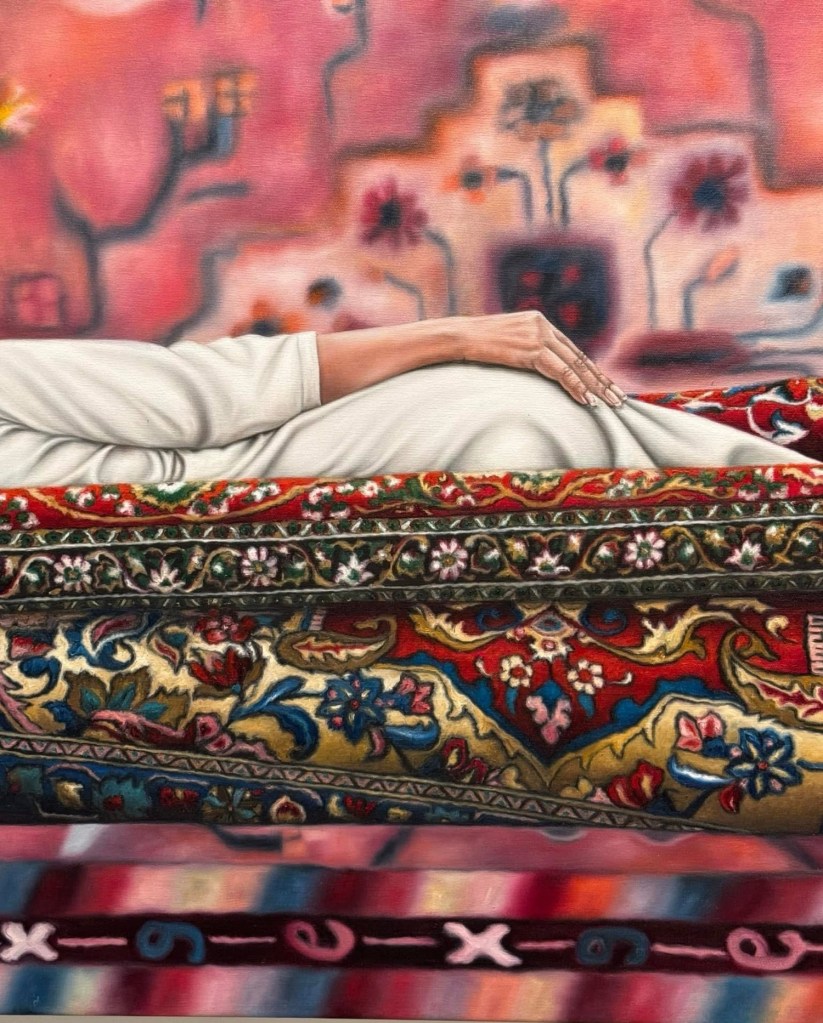
For over a decade, we have witnessed a resurgence of exhibitions on the history of weaving, textile-making, and fiber art in art museums and contemporary art biennales. In the same vein, the Herzliya Museum is devoting its entire space to textile artists. Two of the exhibitions are comprehensive group shows. The exhibition Structures, devoted to weaving in Israel, examines the transitions from functionalism to fiber art. The exhibition Eternal Spring is devoted to the tapestries produced at ItcheMambush’s workshop in Ein Hod from 1966 to 1985, based on paintings by leading artists of the period. The other three are solo exhibitions: Siona Shimshi’s distinctive fabric patterns created from the 1960s to the 1980s, Fatima Abu Roomi paintings, who for years has focused on producing meticulous and painstaking self-portraits that incorporate bits of textiles, carpets, and traditional embroidery, are presented in a show alongside an ornamental rug made of women’s hair, which she created in collaboration with a group of women from Nazareth. Gur Inbar’s exhibition comprises works in ceramics and textiles that combine contemporary with historical aesthetics.
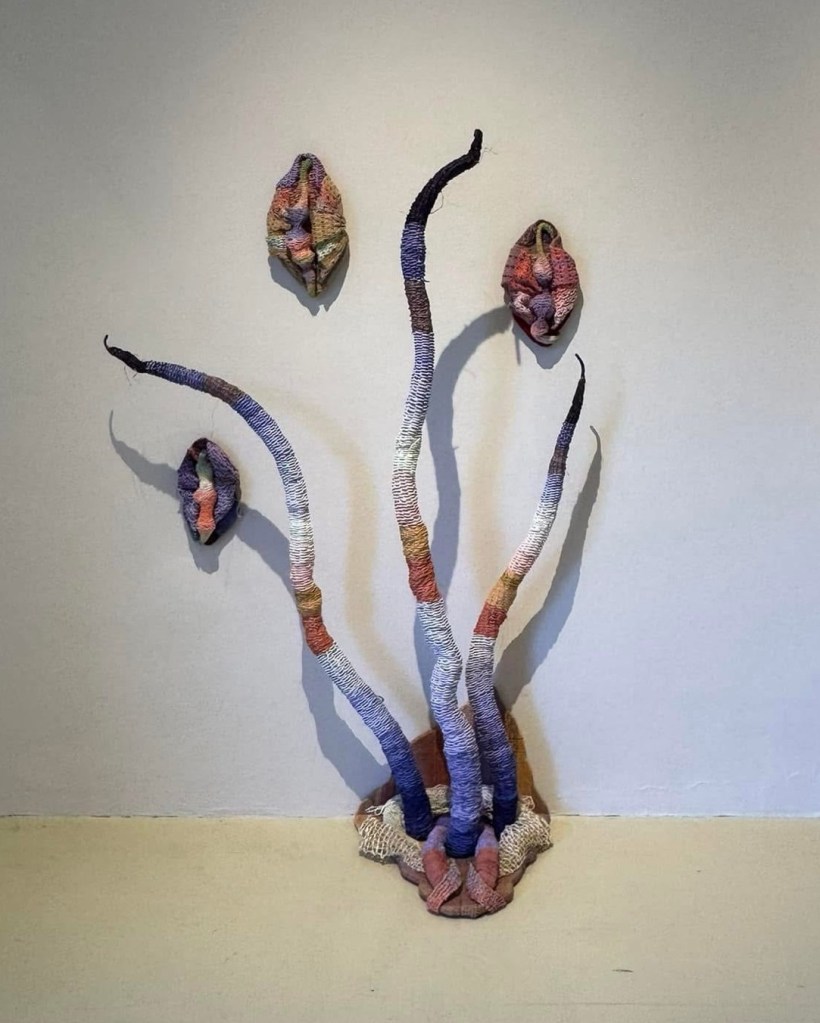
The present exhibitions seek to present an intensive artistic and curatorial exploration of textiles as a medium. They demonstrate the complex processes involved, through a diffusion between design and artistic creation; transitions between handicrafts and mechanical production; an overlap between art and applied art; links between different historical periods and materials; transitions between figurative and abstract; the establishment and dismantling of traditions; the examination of intra-medial issues alongside questions of identity, feminism, gender, rootedness and foreignness; and the reflection of ideological—at times utopian—notions of time and place. These themes are examined in eachone of the exhibitions, as well as in the connections that arise between them.
According to Dr. Aya Lurie, director and chief curator Herzliya Museum of Contemporary Art, “In the past decade, the exhibition program at the Herzliya Museum has striven to explore these issues, to unravel definitions, to merge disciplines together, to re-examine familiar and forgotten works from the Museum’s collection in various ways, and to create intergenerational juxtapositions that offer close encounters with diverse artists—new, familiar, and forgotten, from Israel and abroad—from contemporary interpretive perspectives.”
Structures: Weaving in Israel, from Functionalism to Fiber Art
Group exhibition
Curator: Noga Bernstein
Participants: Ziva Amir, Rachela Angel Hadar, Varda Ben Tal, Mirjam Bruck-Cohen, Gali Cnaani, Nora Frenkel, Yeshaayahu Ish Gabbai, Yael Gelles, Haim Hakimyan, Kathie Halfin, Ruth Kaiser, Yehudit Katz, Julia Keiner, Sima Konson, Tomer Lacham, Shula Litan, Rina Milon, Tal Narkis, Shir Ochayon, Aleksandra (Sasha) Stoyanov, Neora Warshavsky, Roni Yeheskel
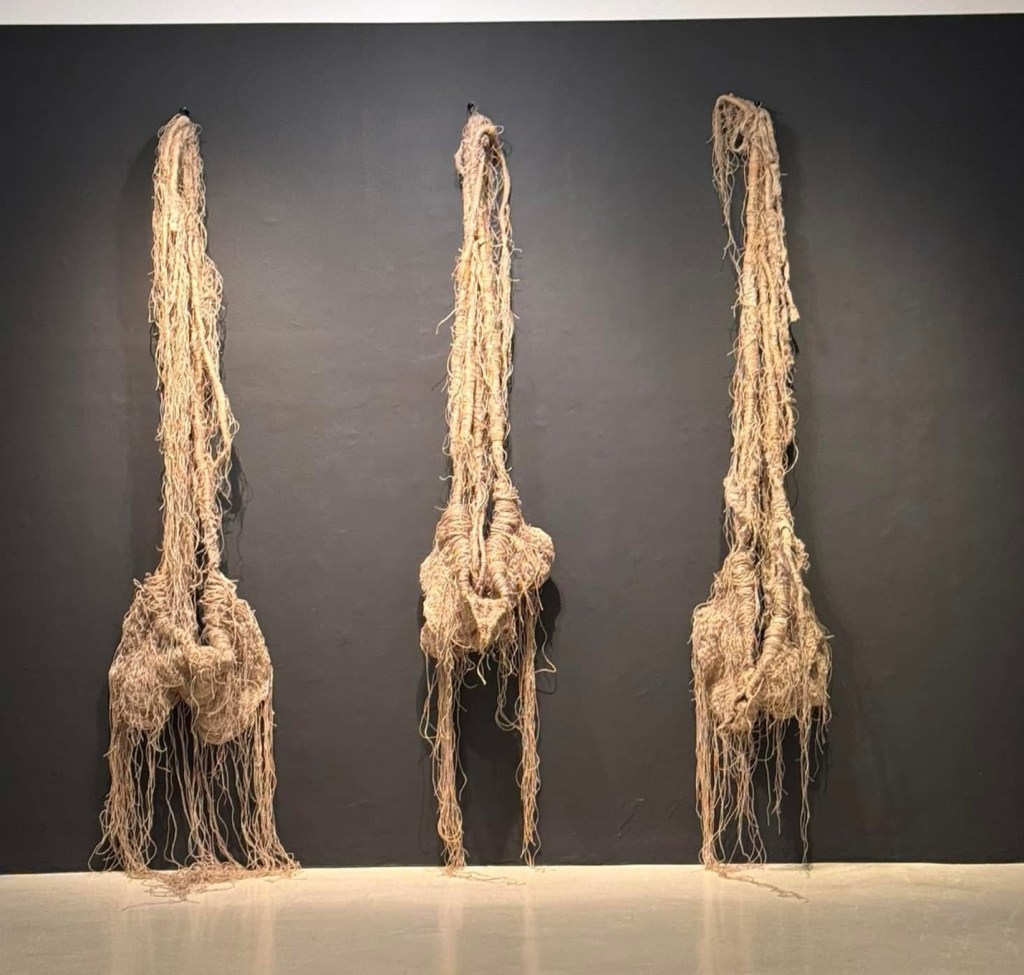
“Two groups of threads intersecting at a right angle,” is how Julia Keiner, one of the pioneers of modernist weaving in Israel, defined the craft of weaving. In her view, the aesthetic expression of woven textiles lies in the structure created by warp and weft by means of a loom. This is the first comprehensive exhibition surveying the history of weaving art and design in Israel. It features works by 22artists active in this field from the 1940s to the present day. The works reflect the wide range of weaving that developed from the principles of Functionalism, displaying both an affinity with a centuries-old tradition and a constant attempt to push its boundaries. The division into sections juxtaposes the historical with the contemporary, and traces the interplay between design, craft, and art; between transnational trends and local circumstances; and between abstract intra-mediumly introspection and an engagement with biographical and political themes.
Throughout history, weaving has been used both for practical purposes—shelter, dress, and insulation—and as an aesthetic and artistic medium, such as tapestry weaving, used to create large-scale “tableaux.” The modernist weaving that developed in the twentieth century sought to challenge the sharp distinction between functionality and aesthetics, and between artist and craftsperson. This new weaving approach was grounded in the notion of Functionalism or Objectivity (Sachlichkeit)—namely, design that not only serves a useful function, but is objectively derived from the material and the production process, be it a utilitarian fabric or a non-functional object for aesthetic consumption. In functionalist weaving the key element of expression is the structure of the weaving itself and the interplay between different weave structures, therefore it is also called structural weaving.
Structural weaving took root in Israel through the Weaving Department at the New Bezalel School of Arts and Crafts that operated from 1941 to 1969, and one of the exhibition spaces is dedicated to its history. In the 1970s, several graduates of the department joined other textile artists in laying the foundations for the development of Israeli fiber art, in direct affinity with the international fiber art movement. They continued to develop structural weaving but pushed the boundaries of the medium and the expressive potential of two- and three-dimensional weaving even further. In the late twentieth century, weaving also developed into a sculptural medium, in some instances produced off-loom through freeform structuring of fibers.
Eternal Spring: Mambush Tapestry Workshop, Ein Hod, 1966–1985
Group exhibition
Curator: Zeela Kotler Hadari
Participants: Mordecai Ardon, Jean (Hans) Arp, Yosl Bergner, Naftali Bezem, Ovadia Alkara, Marcel Janco, Dani Karavan, Aviva Margalit, Abraham Rattner, Anna Ticho, Shraga Weil
Artistic tapestries came back into vogue in the 1960s, in Israel and around the world. “The latest fashion” did not elude the acute senses of the artist Yitzhak (Itche) Mambush, who during those years—along with his wife Aviva Margalit-Mambush and the artist Marcel Janco— was busy establishing and developing the Ein Hod artists’ village.
The first decades in Ein Hod were characterized by a striving to create a place where “artist-artisans,” as they called it, combining high art and crafts, could flourish. Their aspiration was to help young Israeli art grow roots, to assimilate art into daily life, and put artists’ livelihood on a firmer footing. Accordingly, in the late 1950s the Mambushes opened an arts & crafts center in Ein Hod. In its heyday, in the 1970s, it comprised a ceramics workshop, a printmaking workshop, and the pièce de résistance—a tapestry-weaving workshop.
The exhibition presents the tapestries produced at the Mambush workshop after many years of their being hidden from view. These are accompanied by historical items from the workshop and period photographs and films. The presentation of this special enterprise in a museum setting focuses on a chapter that has received little attention untilnow and has been regarded hitherto only a kind of footnote to the work of the artists who designed the tapestries. The weaving workshop at Ein Hod specialized in artistic tapestries, a form of hand weaving on a loom that allows the creation of complex patterns. In this technique, the weft threads are tied on the surface of the warp threads, which remain hidden from view at the end of the process. The craft has its roots in fifteenth-century France. In their technique and iconography, the local (Israeli) and the universal were intertwined. Many of the tapestries depicted Jewish biblical themes, motifs, and symbols, such as the Menorah, Moses’ Tablets, Noah’s Ark, or Mount Sinai. Some were in an abstract style; others depicted the country’s landscapes. Most of the tapestries woven at the workshop were based on specially designated designs by artists, but some were based on existing paintings. The creative process requires a transition from the medium of painting to that of weaving, which requires mastery of quasi-sculptural qualities. The tapestries were suffused with color and vitality, reflecting an impressive colorful audacity, which remains even sixty years later. Some feature a unique technique of blocks combining several hues of color, resulting in complex textures. A handful offered monochromatic and minor-key drawings, in shades of black and white.
Siona Shimshi: Textile Patterns in Her Own Hand
Curator: Yuval Etzioni
This exhibition is centered on printed fabrics designed by Siona Shimshi (1939–2018, Israel), a multidisciplinary artist known primarily for her work as a ceramic sculptor, curator, and writer. Besides the fabrics that she designed between 1963 and 1984, the exhibition also presents archival materials such as sketches, drawings, and ceramic items that provide a visual glimpse into Shimshi’s unique artistic language.
The initial encounter with Shimshi’s printed fabrics is a sensual visual experience. This is the first time that they are presented, allowing the viewer to become acquainted with their unique nature. An iconographic comparison between the fabrics and archival materials of Shimshi’s work and her sculptures reveals a holistic, multidisciplinary output full of recurring themes and patterns. Her characteristic bold contour line and vibrant use of color and texture link together tradition with innovation, ancient motifs with the Zeitgeist of her time, locality with a broad universal perspective. Shimshi did not differentiate between applied art and art and shifted freely between fabric and clay. As she herself attested, her ideas roam between disciplines. In all her output, including her textile works, Shimshi offers vibrant archetypal images anchored in a rich and fascinating cultural repository. Shimshi was born in Tel Aviv and lived there most of her life. She engaged in textile design, ceramic sculpture, jewelry-making, digital work, teaching, curation, writing, and much more. From 1956 to 1959 she studied art at the Avni Institute in Tel Aviv, and in 1959 moved to New York, where she studied ceramics and worked in textile design, including ceremonial ark-curtains for synagogues. After returning to Israel in 1963, she worked at Maskit as a printed-fabric designer and production coordinator. She also designed textiles for other textile companies, such as the weaving Etun and the designer Roji Ben Yosef’s Rikma. Many of her works, such as tapestries and murals, were on display in public spaces. From 1979 to 1988, she headed the Department of Ceramic Design at the Bezalel Academy of Arts and Design, Jerusalem. From the 1980s onward, she was also engaged in research and writing about art and culture in newspapers and periodicals and was generally active in the Israeli art scene.
Close to Herself: Fatima Abu Roomi
Curator: Yael Guilat
The exhibition presents Fatima Abu Roomi’s recurring preoccupation with self-portraiture over two decades as an evolving theme, in which the fabrics and textiles that envelop and cover the protagonist, or are placed next to her, play a key role. The juxtaposition of these works, produced over the years, invites us to observe, experience, and think about the artistic moves—in terms of both style and content—that collectively have contributed to Abu Roomi’s image as a groundbreaking artist. The spectacular beauty of her works is part of the representation of the complexity of her life as a Palestinian woman in Israel, while at the same time revealing the power of resistance that bears the stamp of love.In a series of paintings from recent years, Abu Roomihas depicted her figure carrying rugs and fabrics or standing in front of them, some extending across the canvas, others rolled up like the columns of a temple or as unbearable baggage on her back. Her gaze, withdrawn and focused, forms part of a painterly practice that blurs the clear-cut distinction between image and background, a common motif in Abu Roomi’s early paintings. At times, the rug or fabric depicted serves as a substitute for her own image, as a kind of self-portrait harboring the traces of a private and a collective biography. It is a self-portrait that reflects the conditions and materials from which life is woven, in private and in public, in the domestic and social spheres. Abu Roomi’s works attest to her life in the first person. Being “close to herself,” she stages her testimony to represent the socio-political-gender reality lying behind the veil of reality that is perceived as fact.
Gur Inbar: Yarn of Clay
Curator: Galit Gaon
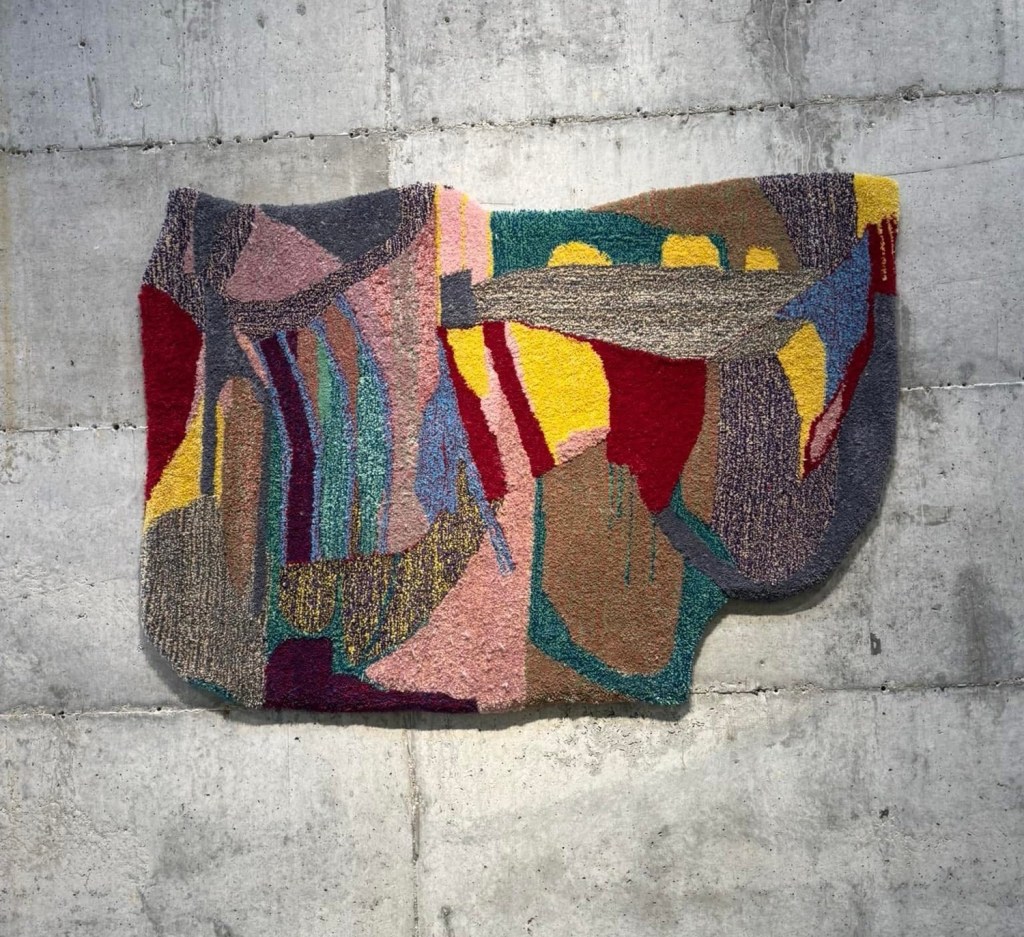
“How do we choose our specific material, our means of communication?” asked textile designer Anni Albers. “Accidentally. Something speaks to us, a sound, a touch, hardness or softness, it catches us and asks us to be formed. We are finding our language, and as we go along, we learn to obey their rules and their limits. We must obey andadjust to those demands.” The question of whether a creator chooses his raw materials, or they choose him accompanies almost every encounter with Gur Inbar. Since graduating in 2015 from the Department of Ceramics and Glass at the Bezalel Academy of Arts and Design, Jerusalem, he has been pushing the boundaries of his work through material flexibility and a colorful vocabulary. In the past year, Inbar has found himself engaged in a new, fascinating and tumultuous learning curve. His hands, which in the past would be frequently covered in wet clay, are now manipulating threads and tying wool fibers to a hanging rug. He uses the ceramic canvas, like the textile one, to develop a colorful and rich language. Gur Inbar’s exhibition attests, like a DNA sample, to the current movement around the world from clay to textiles; old materials, new thoughts.


Deja un comentario