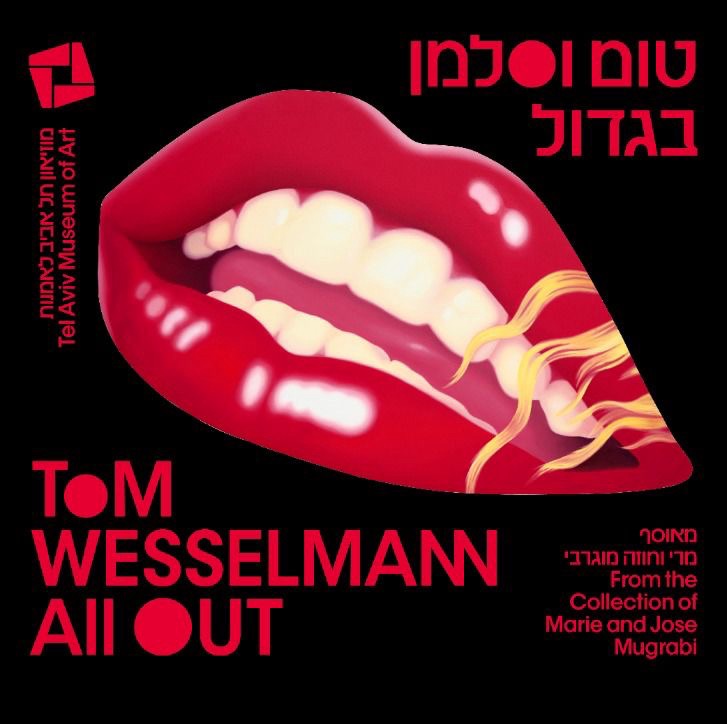
Tom Wesselmann: All Out
From the Collection of Marie and Jose Mugrabi
10 June 2026 – 26 December 2026
Curator: Shahar Molcho | Assistant curator: Alma Lion
Tel Aviv Museum of Art will present the first comprehensive exhibition in Israel dedicated to the work of Tom Wesselmann, one of the leading and most influential figures in 20th-century American Pop Art.
Opening on June 10, 2026, the exhibition features dozens of iconic works from the 1960s and 1970s: monumental images of the human body, still lifes, and everyday objects that evokethe worlds of advertising, beauty ideals, and mass consumer culture.
Wesselmann developed a bold artistic language that blurred the boundaries between the traditions of classical painting and the aesthetics of media, fashion, and advertising. His work exposed the mechanisms underlying popular culture, and continues to resonate today, in an age saturated with images and screens, raising questions about the ways in which gaze, desire, and identity are shaped.i
Tel Aviv Museum of Art presents the first comprehensive exhibition in Israel devoted to American artist Tom Wesselmann (1931–2004), akey figure in American Pop Art. The exhibition offers a contemporary perspective on the work of an artist who redefined the genres of the nude and still life in the second half of the 20th century.
Titled «All Out,» the exhibition brings together more than forty works—oil paintings, works on paper, collages, and readymades—from Wesselmann’s seminal 1960s and 1970s series, including Great American Nude, Still Life, and Bedroom Paintings. The works fuse art-historical traditions of classical painting with the visual language of American consumer culture. They are centered on large-scale, vividly colored images: isolated body parts, flattened figures, and intimate scenes, fragments of domestic life and everyday objects charged with the aesthetics of advertising and mass media, transformed into landscapes of desire within America’s culture of abundance.
Wesselmann’s work emerged at the height of the sexual revolution in the United States. The nude in his works is not an individual portrait, but a constellation of symbols and signs oscillating between idealization and critique of the culture of the spectacle. Through the isolation of body parts—lips, breasts, legs—the nude is transformed from a classical image into a Pop icon: flat, brightly colored, and enlarged, revealing how sexuality and femininity are represented and marketed by the American media. Throughout history, the female nude has been shaped through and for the male gaze. Wesselmann operated within this tension, formulating a language that invites reflection on the ways desire and identity are shaped in the public sphere and, today, also in the digital realm.
At the present moment, marked by a multiplicity of voices alongside growing conservatism and renewed censorship, the exhibition proposes a contemporary reading of body imagery as continually shifting, reshaped and redefined. In this context, it brings Wesselmann’s oeuvre into dialogue with artists from different periods. Alongside his works, the exhibition features pieces from the Museum’s collection by Andy Warhol, Roy Lichtenstein, Alex Katz, Milton Avery, Henri Matisse, Pablo Picasso, Mickalene Thomas, as well as a video work by Doron Solomons.
Tom Wesselmann was born in Cincinnati, Ohio. He studied psychology and served in the U.S. Army during the Korean War, where he began drawing cartoons. In the early 1950s, after his discharge, he moved to New York and was admitted to the Cooper Union, where he encountered Abstract Expressionism and the work of leading artists such as Jackson Pollock, Willem de Kooning, and Mark Rothko. In response to this dominant pictorial idiom,he developed a sharply figurative style with a striking visual presence, drawing inspiration from billboards, magazines, and consumer culture. In the 1960s, he began exhibiting alongside the emerging Pop artists, later incorporating printed materials and external elements which expanded his artisticvocabulary and led to the development of collages and non-traditional formats. During the 1970s and 1980s, he continued working in series that challenged the boundaries of the medium and the relationships between image, materiality, and representation, establishing himself as one of the pivotal figures of American Pop Art.
Tania Coen-Uzzielli, Director of Tel Aviv Museum of Art: «Presenting a comprehensive exhibition in Israel at this particular momentdedicated to Tom Wesselmann—one of the most important and influential artists to emerge in the United States during the 20th century—is a significant achievement for the Tel Aviv Museum of Art. Wesselmann’s work continues to resonate today, inspiring generations of artists working within an image-saturated culture. I would like to thank Marie and Jose Mugrabi for their longstanding support of the Museum, and especially for their commitment during this particularly challengingperiod.»
Following the exhibitions «Andy Warhol 1928–1987″(1992), «WANTED» (2013), which focused on Andy Warhol and Jean-Michel Basquiat, and «Jeff Koons: Absolute Value» (2020), the present exhibition has been made possible through the ongoing collaboration between the Tel Aviv Museum of Art and the Collection of Marie and Jose Mugrabi, one of the world’s leading private collections of contemporary art. This partnership is founded on a shared commitment to making major and rarely exhibited works of art accessible to broad audiences in Israel.


Deja una respuesta